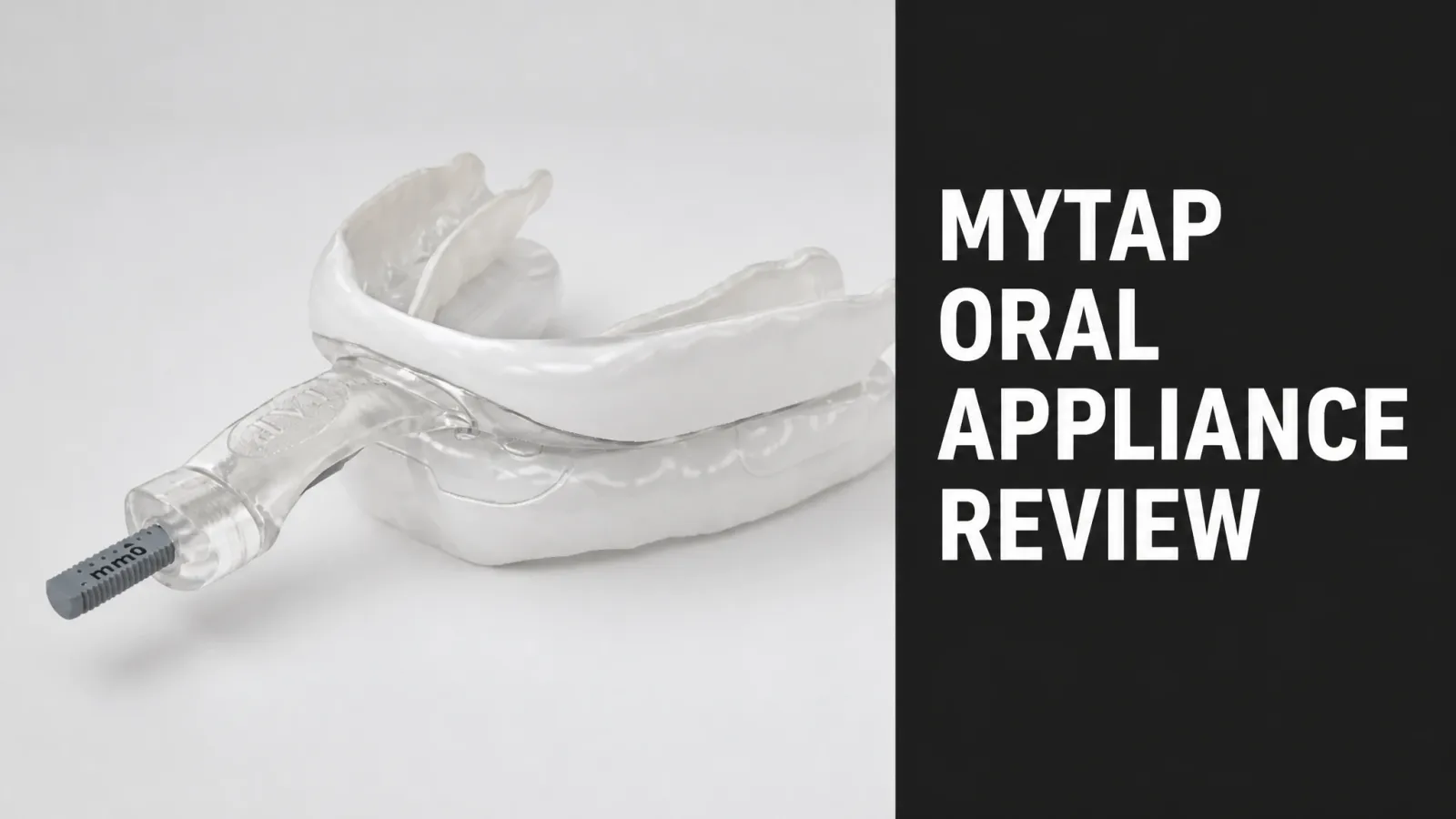
The myTAP oral appliance is an FDA-cleared mouthpiece for snoring and mild to moderate obstructive sleep apnea. Made by Airway Management under the TAP Sleep Care brand, it moves your lower jaw forward to keep the airway open. You mold it at home in about 15 minutes.
Reviewers split into two camps. Fans say it cut their snoring and felt easier than CPAP. Critics say the fit never settled, it shifted their teeth, or it did nothing. It also needs a prescription, so it is not an impulse buy.
So what does that mean for you? Our team at Optimal Weight Plan went through the product specs, clinical notes, and real customer reviews. Here is the full breakdown before you decide.
What Is the myTAP Oral Appliance?
The myTAP oral appliance is a non-custom, precision-fit mandibular advancement device for snoring and mild to moderate obstructive sleep apnea. Airway Management makes it, and TAP Sleep Care markets it. The device is FDA-cleared and is sold only with a prescription.
It has two heat-softening trays, one for the upper teeth and one for the lower. A single adjustment arm sits at the midline. Retailers list the device as a CPAP alternative for people who find masks and hoses hard to live with.
Cpap.com says TAP appliances have been studied in 45 independent, peer-reviewed studies. That is a retailer claim, so treat it as a pointer to the research rather than proof.
Quick Facts:
| Detail | Value |
|---|---|
| Maker | Airway Management (TAP Sleep Care) |
| Intended use | Snoring and mild to moderate OSA |
| Type | Boil-and-mold mandibular advancement |
| Fitting time | About 15 minutes |
| Prescription | Required |
What Comes in the myTAP Box?
The basic kit includes a precision-fit upper and lower tray plus a three-part adjusting system. The adjuster has a tube on the upper tray, a post on the lower tray, and a dial that screws onto the post. A storage case and fitting guide come with it.
Three optional accessories round out the system. The Mouth Shield covers the mechanism and encourages nasal breathing. The AM Aligner helps your bite settle each morning. Vertical shims come in 6, 9, and 12 millimeter sizes.
Optional Accessories:
- Mouth Shield for dryness and nasal breathing
- AM Aligner to settle the bite after use
- Vertical shims (6, 9, and 12 millimeters) to give the tongue more room
How Does the myTAP Oral Appliance Work?
The myTAP works by holding the lower jaw slightly forward so the airway stays open during sleep. A collapsing airway causes the pauses in breathing and the snoring vibration. Moving the jaw tightens the soft tissue and muscles behind it.
TAP's single midline adjuster differs from the two side hinges on many devices. The maker says this design stabilizes the jaw and lets it move more freely. That is a company claim, and independent comparisons are limited.
You turn the dial to advance the jaw in small steps. Sleep Doctor lists up to 22 millimeters (0.87 inches) of travel in one-third millimeter increments. That fine control is what the device is built around.
How Do You Fit and Adjust the myTAP?
You soften each tray in boiling water, bite into it, and let it cool to mold it to your teeth. Cpap.com says the whole job takes about 15 minutes. The trays can be softened and refit if your fit changes.
Then you advance the jaw slowly. Turn the adjustment dial 180 degrees counterclockwise every two to three nights. Stop when your snoring drops and your sleep improves.
Fitting Steps:
- Gather boiling water, tongs, a mirror, and a timer.
- Soften the upper tray in boiling water for 1 minute.
- Let it cool for 20 seconds, then bite down for 1 minute.
- Hold it in place for 3 more minutes while it cools.
- Repeat the process for the lower tray.
- Assemble the adjuster and turn the dial every two to three nights.
What Are the Benefits of the myTAP Oral Appliance?
The myTAP offers a small, quiet, travel-friendly alternative to CPAP. There is no machine, hose, or power cord. Retailers also say it is less disruptive to a bed partner and easier to pack.
Main Benefits:
- No machine, hose, or electricity needed
- Home molding in about 15 minutes
- Fine jaw adjustment with one dial
- Reusable and reheatable trays
- Works with a Mouth Shield to promote nasal breathing
The brand says the Mouth Shield also limits drool and dry mouth. Those are common complaints with oral devices.
Does the myTAP Oral Appliance Actually Work?
Yes, for the right patient. Oral appliances help people with snoring and mild to moderate sleep apnea, and myTAP has early clinical support. The evidence is strongest for that range, not for severe cases.
A July 2026 case report from Sleep Review describes a 45-year-old woman with moderate to severe OSA. Her AHI fell from 25.4 to 13.8 events per hour with myTAP alone. Adding a mouth shield dropped it to 3.6.
To be clear, that is one patient. The authors say future trials need to test long-term results. Your own sleep study is the only real proof for your case.
What Do myTAP Oral Appliance Reviews Say?
Customer reviews split between people who got real snoring relief and people who could not get a good fit. Retail pages show the same pattern. Comfort and fit decide most of the outcomes.
Many reviewers say the first week is the hard part. One mild sleep apnea user says it took 2 weeks to get used to the device. After that, their snoring dropped.
What Do Positive Reviews Say?
Positive reviewers praise the cut in snoring, deeper sleep, and an easy molding process. One buyer, skeptical at first, stopped waking 4 to 5 times a night. Housemates also noticed the snoring stop.
Another reviewer says it reduced snoring significantly after an adjustment period. Patient testimonials on the TAP site go further. One former CPAP user says the device beat six years of mask therapy. Those are brand-curated quotes, so weigh them accordingly.
What Are the Common Complaints?
Negative reviewers report poor fit, shrinking trays, shifting teeth, and no change in symptoms. One cpap.com reviewer says it did not reduce symptoms and felt incredibly uncomfortable. Another could not get an accurate fit but received a refund easily.
A Sleep Doctor reviewer says the molded trays shrank too much. One user reports a useful life of about 2 years. Here is the kicker: any oral device can move teeth over time, so regular dental checkups matter.
Review Summary:
| Theme | What Reviewers Say |
|---|---|
| Snoring | Often reduced after a short adjustment period |
| Fit | Easy for some, frustrating for others |
| Comfort | Takes days to weeks to get used to |
| Durability | One reviewer reports about 2 years |
myTAP vs CPAP and Other Sleep Apnea Options?
The myTAP suits mild to moderate sleep apnea, while CPAP remains the standard for more serious cases. Cpap.com says the device is not suitable for severe OSA. Your sleep doctor decides which therapy fits your numbers.
TAP also sells a TAP PAP, which is a nasal pillow CPAP mask anchored to a mouthpiece. The brand positions it for more serious cases. Lifestyle changes and surgery are the other routes.
Options Compared:
| Option | Best For | Main Trade-Off |
|---|---|---|
| myTAP | Snoring, mild to moderate OSA | Fit and jaw discomfort |
| CPAP machine | All severity levels | Mask, hose, and noise |
| TAP PAP mask | More serious OSA | Still needs a CPAP machine |
| Lifestyle changes | Mild cases | Slow, needs consistency |
| Surgery | Last resort cases | Invasive |
Is the myTAP Oral Appliance Safe?
Yes, for suitable patients using it under medical guidance. The myTAP is FDA-cleared for snoring and mild to moderate sleep apnea. Cpap.com says it requires an active prescription and dental oversight.
Side effects are mostly mechanical. Expect jaw soreness, tooth pressure, and extra saliva or dryness early on. Some users report shifting teeth. A dentist can check your bite over time.
Untreated sleep apnea carries real health risks. Do not self-diagnose from snoring alone. Get a sleep test first.
Who Should Avoid the myTAP Oral Appliance?
People with severe sleep apnea or certain dental problems should skip it. Cpap.com lists braces, loose teeth, or too few healthy teeth per arch as examples. Anyone with sensory issues who cannot tolerate a mouthpiece should explore other options.
Not Recommended For:
- Severe obstructive sleep apnea
- People with braces or loose teeth
- People with too few healthy teeth per arch
- Anyone who cannot tolerate objects in the mouth during sleep
How Much Does the myTAP Oral Appliance Cost?
Retail prices vary by seller, and the device requires a prescription before it ships. Our research did not confirm a single current list price, so check the live listing at Sleep Doctor or cpap.com. Prices change often.
Insurance may help. Sleep Doctor says most plans cover a custom TAP appliance under billing code E0486 in many cases. Your out-of-pocket cost depends on your plan.
Where to Buy:
- Sleep Doctor (sleepdoctor.com)
- cpap.com
- Sleep dentists who offer TAP appliances
Is the myTAP Oral Appliance Worth the Price?
It depends. The device earns its price if you fit well and your snoring or mild apnea improves. A boil-and-mold design costs less than a lab-made custom appliance.
Check the return terms first. Sleep Doctor offers a full refund on unopened, unused product within 30 days. It also lists a 90-day warranty with stipulations. Opened devices may be limited to store credit.
Is Optimal Weight Plan Worth It?
A mouthpiece handles the airway. Daily habits handle the rest. Our team at Optimal Weight Plan cannot treat sleep apnea, and we will not pretend otherwise. But our coaches help you build steady routines around sleep, food, and movement.
Extra weight can worsen sleep apnea, and poor sleep wrecks cravings. A simple, coach-backed plan keeps the basics steady while your sleep doctor handles treatment.
Ready to build a plan that fits real life? Book a free call with our coaches and start with a routine built around you, not a generic template.