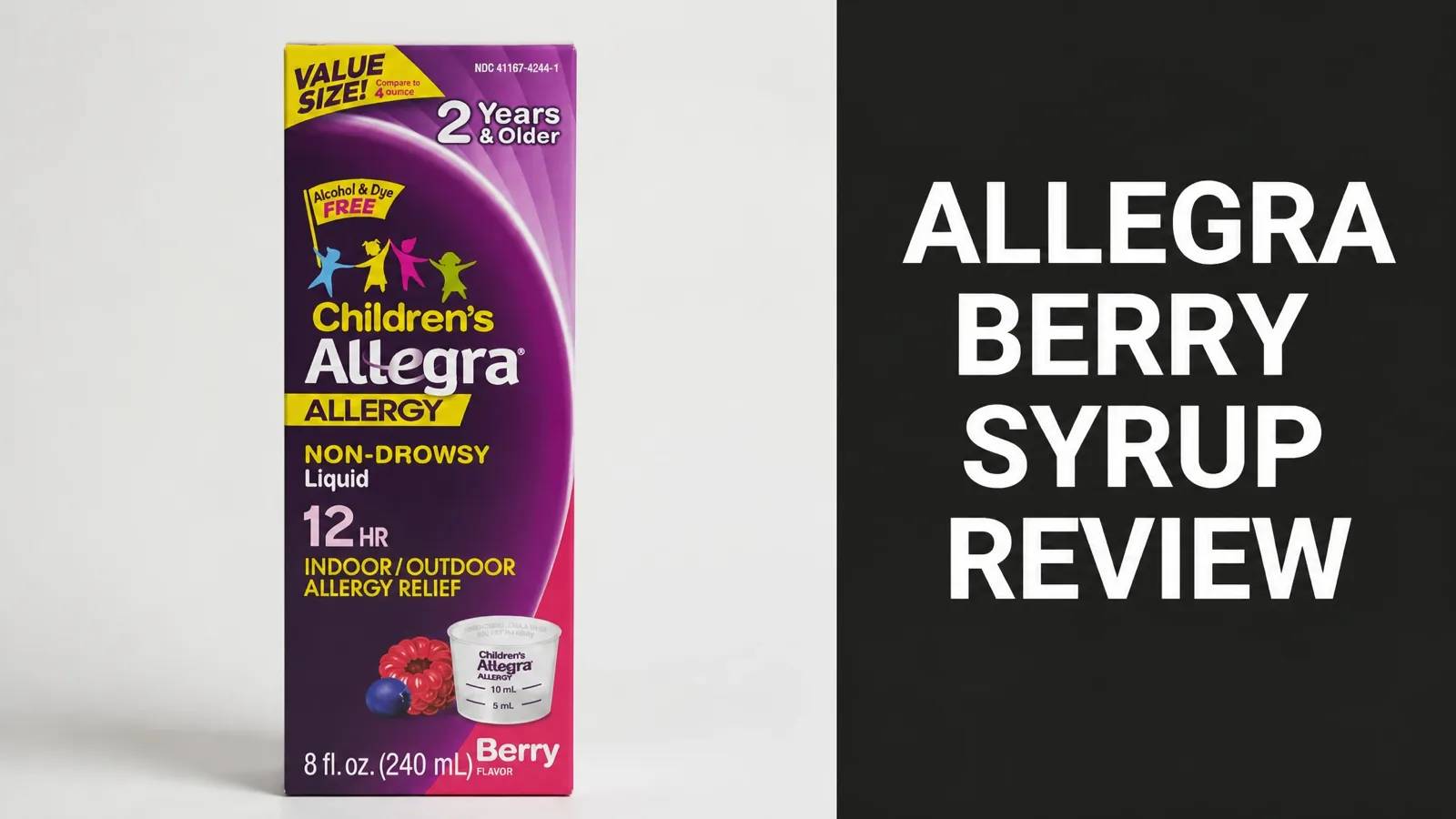
Allegra Children's Allergy Relief Berry Syrup is a non-drowsy liquid antihistamine built for kids ages 2 to under 12. Fexofenadine hydrochloride powers the formula, targeting sneezing, runny nose, and itchy eyes from both indoor and outdoor allergens.
Parents want proof before committing to a bottle. Fexofenadine blocks histamine without crossing into the brain in meaningful amounts, so kids stay alert through school. Relief starts within an hour and holds for 12 hours. Retail reviews average 4.7 out of 5 stars, with taste and non-drowsy performance as the most common praise.
Zyrtec acts faster and Claritin lasts longer, but Allegra wins on alertness. This review breaks down how it works, what real reviews say, the side effects to watch for, and how the price compares before you buy a bottle for your child.
What Is Allegra Children's Allergy Relief Berry Syrup?
Allegra Children's Allergy Relief Berry Syrup is a liquid antihistamine made for kids ages 2 to under 12. The berry-flavored formula treats sneezing, runny nose, and itchy, watery eyes from indoor and outdoor allergens. Fexofenadine hydrochloride is the active ingredient behind the relief.
Sanofi markets Allegra as the number-one allergist-recommended non-drowsy children's allergy brand. The syrup is alcohol-free and dye-free. Parents give it once every 12 hours, and one bottle covers pollen, ragweed, grass, trees, and pet dander triggers year-round.
The berry flavor blends natural grape and artificial raspberry cream flavoring with xylitol for sweetness. Xanthan gum keeps the suspension smooth between shakes. This combination makes daily dosing easier for kids who reject bitter medicine.
What Is the Active Ingredient in Allegra Children's Syrup?
Fexofenadine hydrochloride at 30 mg per 5 mL drives every dose of Allegra Children's syrup. This second-generation antihistamine blocks histamine receptors without crossing into the brain in meaningful amounts. That size difference separates fexofenadine from older, sedating antihistamines.
Inactive ingredients round out the formula. Sodium phosphate compounds adjust pH. Disodium edetate acts as a preservative. Titanium dioxide provides the syrup's coloring, and propylene glycol carries the flavoring evenly through each dose.
Ingredient Snapshot:
- Fexofenadine HCl 30 mg per 5 mL (active)
- Natural grape and artificial raspberry cream flavor
- Xylitol and sucrose for sweetness
- Xanthan gum for suspension texture
- Propylene glycol and potassium sorbate
How Does Allegra Children's Allergy Relief Work?
Allegra blocks the H1 histamine receptors that trigger sneezing, itching, and watery eyes. Histamine floods the body during an allergic reaction. Fexofenadine occupies those receptor sites first, and the allergy symptoms never fully develop.
The molecule's size keeps it out of the central nervous system. Older antihistamines like diphenhydramine cross the blood-brain barrier easily, and that crossing causes drowsiness. Fexofenadine mostly stays in the bloodstream instead, which is why Allegra markets itself as non-drowsy.
Relief starts within one hour of the first dose. The effect then holds steady for 12 hours, covering a full school day or an afternoon outdoors. Parents give a second dose 12 hours later to maintain continuous coverage.
Why Doesn't Allegra Cause Drowsiness?
No, Allegra does not cause meaningful drowsiness in most children. Fexofenadine's molecular structure limits its ability to enter brain tissue. Allegra's own materials describe this as "0% brain interference," a claim built on the drug's low central nervous system penetration.
Zyrtec, by comparison, crosses the blood-brain barrier more readily and causes drowsiness in a larger share of users. Claritin sits between the two. Parents who need a child alert for schoolwork or sports often choose Allegra specifically to avoid that tradeoff.
What Are the Benefits of Allegra Children's Allergy Relief?
Allegra Children's syrup delivers fast, non-drowsy relief from the most common seasonal and indoor allergy symptoms. The formula targets runny nose, sneezing, itchy throat, and itchy or watery eyes. Twelve-hour dosing means most kids need it only twice a day.
The berry flavor removes one of the biggest barriers to consistent dosing: refusal. A child who spits out bitter medicine gets inconsistent symptom control. Allegra's sweetened, dye-free formula solves that problem for most families without added struggle.
Key Benefits:
- Non-drowsy formula for school and daytime activity
- Fast-acting relief starting within one hour
- 12-hour coverage from a single dose
- Covers both indoor and outdoor allergen triggers
- Alcohol-free and dye-free liquid base
Does Allegra Actually Relieve Allergy Symptoms?
Yes, Allegra relieves the core symptoms of seasonal and indoor allergies in most children. Clinical data behind fexofenadine shows measurable reductions in sneezing, nasal congestion, and eye irritation compared to placebo. Retail customer ratings echo that same result at scale.
Target's own product page shows a 4.7 out of 5 star average across 409 reviews, with 94% of reviewers saying they would recommend it. Effectiveness scores as 4.7 out of 5 in that same dataset, which places Allegra among the stronger-rated kids' allergy liquids on the market.
Does Allegra Keep Kids Alert During the Day?
Yes, most parents report their children stay alert and focused after taking Allegra. Reviewers specifically credit the non-drowsy formula with letting kids "remain active and focused" through school hours. That distinction matters most during exam weeks or sports seasons.
Quality ratings for the product sit at 4.6 out of 5 in the same review dataset. Consistency between the alertness claims and the quality score suggests the non-drowsy positioning holds up under real-world daily use, not just in a lab setting.
What Do Allegra Children's Reviews Say?
Parent reviews of Allegra Children's syrup lean heavily positive, with an average rating near 4.7 out of 5 stars. Most praise centers on the berry flavor, the non-drowsy effect, and the speed of relief. A smaller share of reviewers describe inconsistent results.
Value scores land at 4.5 out of 5, slightly behind effectiveness and quality. That gap reflects the brand-name price tag rather than any doubt about performance. Parents who prioritize results over cost still rate the product highly overall.
Positive Experiences
Reviewers repeatedly single out the "pleasant berry flavor" as the reason dosing goes smoothly. A child who takes medicine without a fight gets consistent 12-hour coverage. Consistent dosing, in turn, produces the steady symptom control that drives the high satisfaction scores.
What Parents Praise Most:
- Pleasant berry taste kids accept without a fight
- Quick action within the first hour
- Long-lasting relief through a full school day
- No noticeable drowsiness or mood change
Common Complaints
At least one reviewer reported the syrup "has not made any changes" for a child's hay fever symptoms. Individual response to any antihistamine varies by allergy type and severity. Fexofenadine works well for histamine-driven symptoms, but it does less for congestion caused by other triggers.
A handful of parents also flag the price as steep compared to store-brand fexofenadine or loratadine alternatives. The brand name and berry flavoring both add cost. Families on a tight budget sometimes switch to generic fexofenadine once they confirm the ingredient works for their child.
Allegra vs Zyrtec vs Claritin for Kids: Which Is Best?
Allegra causes the least drowsiness of the three major kids' antihistamines, while Zyrtec acts fastest and Claritin sits in the middle on both counts. Each drug blocks the same histamine pathway through a different molecule, and that molecular difference explains the tradeoffs parents notice.
Kids' Antihistamine Comparison:
| Brand | Active Ingredient | Onset | Drowsiness Risk | Min. Age |
|---|---|---|---|---|
| Allegra | Fexofenadine | Within 1-2 hours | Lowest | 2 years |
| Zyrtec | Cetirizine | As fast as 1 hour | Highest of the three | 6 months |
| Claritin | Loratadine | Up to 3 hours | Low to moderate | 2 years |
Zyrtec edges out Allegra on speed and overall symptom control in some comparisons, but that edge comes with a higher chance of tiredness. Claritin takes longer to kick in and covers symptoms for a full 24 hours instead of 12. Allegra's twice-daily schedule fits families who prefer a fixed morning-and-evening routine.
Age range breaks the tie for younger toddlers. Zyrtec is approved down to 6 months, while Allegra and Claritin both start at 2 years. Parents of infants and very young toddlers do not have Allegra as an option regardless of its alertness advantage.
What Are the Side Effects of Allegra Children's Syrup?
Allegra carries a low side effect profile compared to older, first-generation antihistamines. Reported reactions are generally mild and infrequent. Most children tolerate the syrup without any noticeable change in behavior or energy.
Reported Side Effects:
- Headache in a small share of users
- Mild stomach upset if taken with certain juices
- Rare drowsiness despite the non-drowsy formula
- Allergic reaction to an ingredient, in isolated cases
Fruit juices reduce fexofenadine absorption when taken together, which can blunt effectiveness rather than cause harm. Aluminum and magnesium antacids carry the same interaction warning. Spacing the syrup away from juice and antacids by a couple of hours avoids the issue entirely.
Who Should Avoid Allegra Children's Allergy Relief?
Children under 2 years old should avoid Allegra Children's syrup without a doctor's direct guidance. The product is formulated and dosed specifically for the 2-to-under-12 age range, and safety data below that threshold is limited.
Who Needs Medical Guidance First:
- Children under 2 years of age
- Kids with diagnosed kidney disease
- Anyone with a known allergy to fexofenadine or the syrup's inactive ingredients
- Pregnant or breastfeeding caregivers dosing themselves with adult Allegra
Kidney function affects how the body clears fexofenadine. A pediatrician typically adjusts the dosing interval for kids with kidney disease rather than ruling out the drug entirely. That adjustment keeps the medication in a safe range for those specific cases.
How Much Does Allegra Children's Berry Syrup Cost?
An 8 fl oz bottle of Allegra Children's Berry Syrup costs around $19.99 at major retailers, or about $2.50 per fluid ounce. Smaller 4 oz bottles run proportionally similar per-ounce pricing. Multi-packs at warehouse retailers sometimes bring the per-bottle cost down further.
Price by Retailer (approximate):
| Retailer | Size | Price |
|---|---|---|
| Target | 8 fl oz | $19.99 |
| Amazon | 4 fl oz | $10-13 |
| Walgreens | 4 fl oz | $11-14 |
Is Allegra Worth the Price?
Yes, Allegra is worth the price for families who need reliable non-drowsy relief and a flavor their child will actually take. The premium over generic fexofenadine covers brand-consistent dosing accuracy and the berry flavor formulation. Store-brand fexofenadine offers the same active ingredient for less.
Families focused purely on cost per dose often start with the store-brand version first. Parents who have already had a bad experience with taste refusal, or who want the name-brand consistency, tend to stick with Allegra despite the higher shelf price.
Where to Buy Allegra Children's Allergy Relief Berry Syrup?
Allegra Children's Berry Syrup is available at nearly every major pharmacy and grocery retailer in the United States. Target, Walmart, Walgreens, and Amazon all stock the product, along with regional grocery chains and warehouse clubs.
No prescription is required. The syrup sits on the over-the-counter allergy aisle alongside adult Allegra and competing brands. FSA and HSA funds typically cover the purchase, since it is an FDA-regulated over-the-counter medication for a diagnosed condition.
Buying in-store lets a parent compare the 4 oz and 8 fl oz sizes side by side before committing. Online ordering through Amazon or a retailer's website adds convenience for families who prefer auto-restocking before allergy season peaks.
Should You Try Optimal Weight Plan's Approach to Kids' Allergies?
Allergy symptoms and stalled weight loss goals often trace back to the same root causes: inflammation, poor sleep, and inconsistent routines at home. Our team at Optimal Weight Plan looks at the whole family's health picture, not just one bottle on the medicine shelf.
You already know Allegra can calm your child's sneezing and itchy eyes without the afternoon slump. Now think bigger. Our coaches at Optimal Weight Plan help you build the daily habits that keep your whole family feeling better, all year, not just during allergy season.
Ready to take the next step? Book a free call with our experts and get a personalized plan built around your family's real goals.